Preparing a multifamily property for resident EV charging
As more drivers switch to electric vehicles, property owners who manage apartments, condos, or townhome communities are starting to hear from residents who want a place to plug in at night. The request sounds simple: "Can I charge my car here?" But behind that question lies a set of decisions about electrical capacity, parking lot layout, billing, and long-term maintenance. Getting ready for resident EV charging is not just about installing a few boxes on the wall. It is about thinking through how the system will work for everyone who lives there, today and a few years from now.
This article walks through what a property owner needs to consider when planning for EV charging in a shared parking environment. The goal is to help you understand the options, the trade-offs, and the practical steps so you can have informed conversations with contractors and make choices that suit your building and your residents.
Start with a site assessment
Before any equipment is ordered, a thorough site assessment is the first step. An electrician or a qualified consultant will look at the building's existing utility service, the distance from the main electrical panel to the parking area, and the condition of the parking lot itself. They will also note the number of parking spaces and how they are assigned. Some properties have reserved spots for each unit; others have open parking where residents park wherever space is available. That distinction matters when deciding how many chargers to install and where to put them.
The site assessment also checks the load profile of the building. How much spare electrical capacity does the property have? If the building already runs air conditioning, elevators, pool pumps, and laundry rooms, the available power for EV charging may be limited. Upgrading the utility service can be expensive, so many properties look at load management systems that share the available power across multiple chargers without exceeding the building's capacity.
Decide on the charging approach
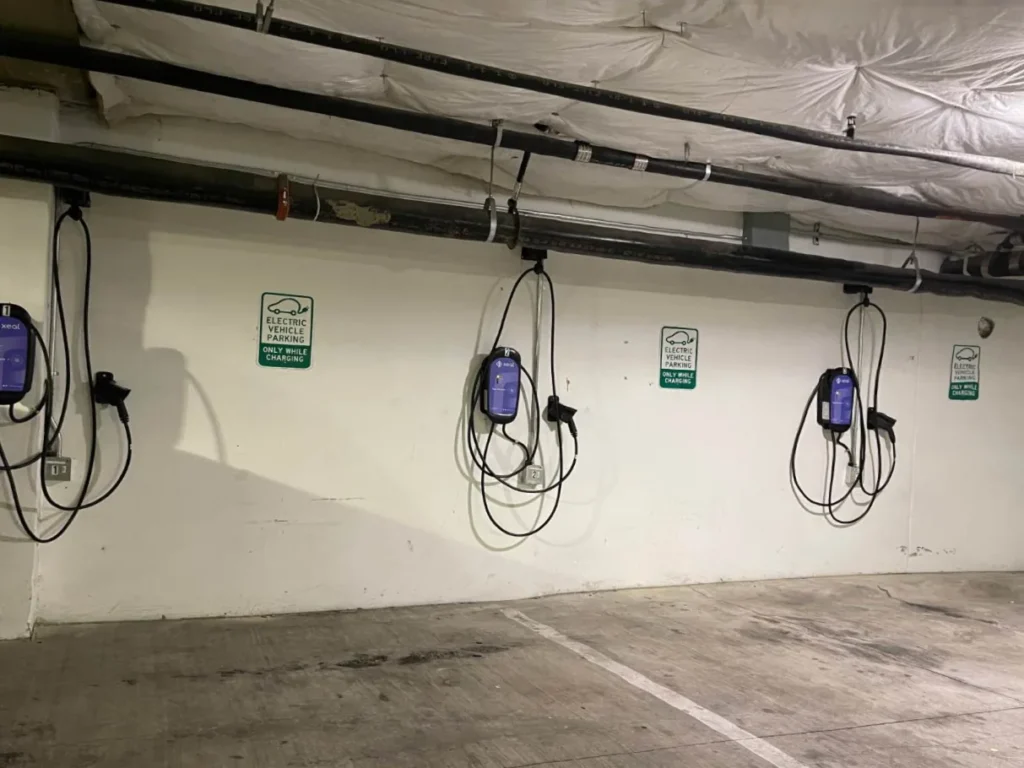
There are a few common ways to set up EV charging in a multifamily setting. One option is to install a dedicated charger for each parking space that a resident uses. This works well when parking is assigned and the property wants to give each resident their own billing. Another approach is to install a smaller number of shared chargers in common areas, such as near the entrance or in a visitor lot. Shared chargers can serve more residents with less equipment, but they require a system to manage who plugs in and for how long.
A third option is to run conduit and wiring to each parking space now, even if the charger itself is not installed yet. This "future-proofing" approach lets you install the expensive underground work during a parking lot repaving or construction project, then add the chargers later as demand grows. It costs more upfront but avoids tearing up the parking lot again in a few years.
Think about access control and billing
Once you decide where the chargers go, you need to decide who can use them and how they pay. For a multifamily property, the simplest setup is a charger that works with a key fob or an app. Only residents who have been granted access can start a charging session. This prevents non-residents from using the equipment and helps track usage.
Billing can be handled in several ways. Some properties include the cost of electricity in the monthly rent or HOA fees, which is simplest but can lead to inequity if some residents drive more than others. Other properties use networked charging stations that track each session and bill the resident directly, either through a credit card or by adding the charge to their monthly statement. Networked charging also gives property managers data on usage patterns, which helps when planning future expansions.
For properties that want to avoid the complexity of individual billing, a flat monthly fee for EV charging is a middle ground. Residents pay a set amount each month, and they can charge as much as they want. This works best when the number of EVs is small and the cost of electricity is predictable.
Consider parking capacity and layout
Parking capacity is a practical concern. If your property has more residents than parking spaces, adding EV chargers can make the situation worse if chargers are installed in prime spots. Some properties designate a few spaces near the building entrance as EV-only, which can frustrate residents who do not drive electric cars. A better approach is to spread the chargers throughout the lot, so no single area is monopolized. Another idea is to install chargers in a less convenient part of the lot, reserving the best spots for general parking.
The layout also matters for cable management. Chargers mounted on a wall or a pedestal should be placed so the cable does not create a tripping hazard across a walkway or a driving lane. Some properties install overhead cable management systems that keep the cord out of the way when not in use. Others use floor-mounted bollards that protect the charger from being hit by a car.
Plan for the electrical infrastructure
The electrical work is the most technical part of the project. Running conduit from the main panel to each parking space requires careful planning. The electrician will need to consider the distance, the wire size, and the voltage drop. For a large property, a dedicated transformer or a sub-panel near the parking lot may be necessary. This is where the concept of commercial charging infrastructure comes into play. Even though the property is residential, the scale of the installation - multiple chargers, load management, and metering - often requires the same kind of planning and equipment used in commercial settings.

Load management is a key tool for keeping costs down. Instead of installing a 60-amp circuit for each charger, a load management system can connect several chargers to a single circuit and automatically adjust the power each charger draws based on how many are in use. This allows more chargers to be installed without upgrading the building's main service. It also helps avoid peak demand charges from the utility, which can be a significant cost for larger installations.
Another consideration is the type of charger. Level 2 chargers are the standard for overnight charging in multifamily properties. They deliver enough power to fully charge most EVs in a few hours. Level 1 charging from a standard household outlet is too slow for shared use and is not recommended for new installations. DC fast chargers are expensive and unnecessary for overnight use; they are better suited for public charging along highways.
Work with the utility company
Before construction starts, it is wise to contact the local utility company. Many utilities offer incentives for installing EV charging in multifamily properties, such as rebates on equipment or reduced rates for off-peak charging. The utility can also provide information about the available capacity on the grid in your area. In some cases, the utility may require a new service transformer or a separate meter for the chargers. These conversations should happen early, because utility upgrades can take months.
The utility may also have requirements for the type of meter used. Some properties install a single meter for all the chargers and then use the network software to bill residents. Others install a separate meter for each charger. The choice affects the cost and the complexity of the billing system. A single meter with sub-metering is often the most cost-effective solution for properties with many chargers.
Prepare for ongoing maintenance
EV charging stations are electronic devices that need occasional maintenance. The charging cable and connector are the most likely parts to wear out, especially in a shared environment where people are plugging and unplugging daily. The network software also needs updates. Some properties contract with a service company that handles maintenance and repairs, while others rely on the property maintenance staff to handle basic issues like resetting a tripped breaker.
It is also important to have a plan for what happens when a charger breaks. If the property has only two chargers and one goes down, residents who rely on that charger may be stranded. A good rule is to install at least one more charger than the current number of EVs, to provide a buffer. This is where the idea of commercial charging infrastructure becomes relevant again. A system designed for commercial use typically has better reliability and support than a consumer-grade unit, and it is worth considering for any installation with more than a handful of chargers.

Communicate with residents
Finally, do not forget to talk to the residents. Before installation, send out a notice explaining the plan, the timeline, and how the chargers will be managed. Ask residents who already own EVs to register their interest, so you can gauge demand. After installation, provide clear instructions on how to use the chargers, how billing works, and who to contact if there is a problem. Good communication reduces confusion and complaints.
Resident demand for EV charging will only grow. By planning carefully now - assessing the site, choosing the right equipment, thinking about access and billing, and working with professionals - you can add charging capability that serves your residents well and protects the value of your property. The investment may seem large, but a well-planned installation avoids costly retrofits later and keeps your property competitive in a changing market.
Ends · PARKINGPOWER